On The Hungry Lion Attacking an Antelope
The environment functions much like the unconscious—often preferred to remain in the background. Bringing it into the foreground is akin to the return of a repressed sense of its agency. In the work of Henri Rousseau, this agency is particularly evident in his treatment of plants. His compositional unit, much like Piet Mondrian’s grid, is the leaf. Although Rousseau never visited a tropical region—relying instead on the natural history museum for reference—the majority of his popular works depict lush jungle scenes. These scenes feature a wide variety of plants, with relatively few non-human animals.
This creates a kind of symbiosis between figure and ground, or between animal and plant, evoking an ecological perspective in which the survival of an organism is intimately tied to the survival of its environment. For instance, in the image of the lion consuming an antelope, a curious creature appears in the lower-left corner. Could this be read as the agency of the ecosystem making its presence felt?
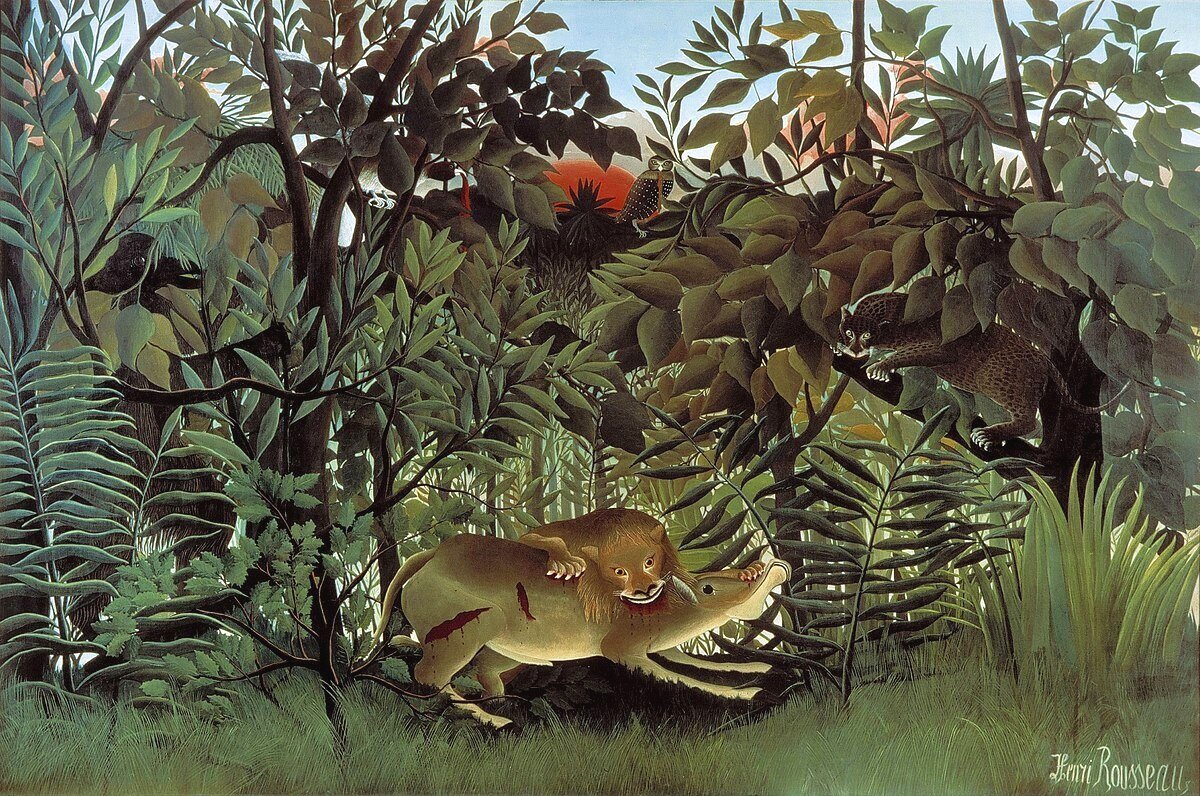
The Hungry Lion Throws Itself on the Antelope (Le lion ayant faim se jette sur l'antilope) is a large oil-on-canvas painting created by Henri Rousseau in 1905.